Wednesday, March 24, 2010

SXSW Day 1, March 17, 2010


SXSW: The View from Austin

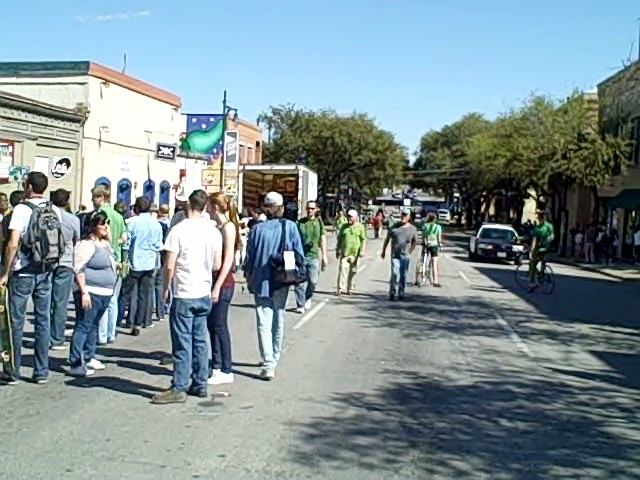
SXSW 2009 was one of the high points of my life, so I was thrilled to be asked to be a panel moderator at this year's SXSW. Based on the assumption that a picture's worth a thousand words, I'm going to just give a final overview of this year's event, and then post lots of pictures. HIGH POINTS-The Keeping It Real Hip-Hop Panel, the Where They At bounce music exhibit at the Birdland Gallery, the Louisiana Music tent performances, great food everywhere, but especially at the Omelettry, 24 Diner, Pappadeaux, Texas Land and Cattle, Kerbey Lane Cafe and the Hut Hamburgers, spending way too much money at Waterloo Records, getting to see Billy Bragg live at Prague, the Nappy Roots show at ND, the lakefront Texas NARAS reception, running into lots of friends, including Matt Sonzala, Michael "5000" Watts, Kazy D, Ms. Tee, DJ Jubilee, Big Sid, Quietus Khan, Pete Johnson from Select-O-Hits, Partners-N-Crime, Skipp Coon, Truth Universal and Cameron Mann from the Memphis Music Foundation, and the Austin Record Show in the convention center. LOW POINTS-The death of Alex Chilton (who was supposed to be the honoree at this year's SXSW), parking and congestion problems, particularly in East Austin, the lack of shuttles to SXSW events, the unexpected cold snap Saturday morning which also ruined the Sunday softball event for me, extremely crowded venues everywhere, many standing room only, and some where you could not see the performers on stage for the crowds, and losing my leather iPhone case while running underneath I-35 toward the Music Gym. I spent way too much money, and wore myself out, but I had a great time, conducted some business, hopefully educated some young artists and can't wait to go back next year, Lord willing.

Sunday, March 14, 2010

The Gathering Storm: Youth Violence in Memphis

A couple of weeks ago, on the first really warm Saturday of the year, I was driving back from the library down Tillman Street through Binghampton, through crowds of youths that were somewhere on the spectrum between a street carnival and something more ominous. The couple of hundred people or so were gathered around an incipient fight between two youths who were standing face to face. As I drove past, through the open window I heard someone yell "Hit that nigga!", and when I looked into the rear-view mirror, the young men had begun fighting in earnest. Yesterday, however, the violence of the nearby Binghampton neighborhood invaded the halls of the Memphis Public Library itself, when three youths' argument in the lobby turned into a full-scale brawl, frightening two older African-American women in the bookshop, who said to each other (and me) "What's wrong with these kids?" The security guards separated them with some difficulty, and the police were called. By the time I decided to leave the library, the police had made the young men sit down on the sidewalk in front of the library as they took names and addresses. I wanted to yell at them "Where is all this rage coming from? Don't you know how short life is? Don't you know the sacrifices your ancestors made so you could have the opportunities you're so casually throwing away?" But instead I walked past toward my car, overhearing one of the boys explaining to a police officer that one of the other youths had displayed a red "flag", a bandana used to symbolize the Bloods gang. Apparently, the police believed there could be further trouble, because as I left the library, I noticed that a police cruiser was posted up at East High School down the street, and another to the west at Tillman and Walnut Grove. When something like this happens, and it's big enough to make the news, the internet comments locally are full of blatant or implied racist comments, as if the young people's Blackness was an explanation for the violence. But today at the library, it was easy to see the bewilderment on the faces of many Black adults as well, police, security guards, library employees and passers-by. They are just as confused by the behavior of inner-city young people today as are suburban whites. It is clear that something has to be done before Memphis reaps a terrible harvest of violence. And blaming people because of their skin-color or race does nobody any good.

Friday, March 12, 2010

The Case For Keeping Bartlett Cops At Home

Yesterday, Bartlett police officers ventured into North Memphis to serve a drug warrant, and ended up killing 43-year-old Malcolm Shaw, who may or may not have been the person being served with the warrant. The killing immediately stirred up a firestorm of controversy, as well as a rebellious crowd of hundreds in the neighborhood. Most of the defense of the Bartlett police online has centered around the dead man being a criminal who pulled a gun on police and thus deserved to die (although I always thought warrants were served to bring people to court for trial, and that, until convicted, a suspect is not a criminal), and that the Bartlett police legally do have the right to serve warrants in Memphis under Tennessee law. However, as a resident and taxpayer of Bartlett, I am not concerned with whether it is legal for Bartlett police to serve warrants in Memphis, or whether they followed proper procedure. I believe it is in the best interests of Bartlett and its citizens to restrict Bartlett police to working within the city limits of Bartlett only. Here are my reasons:

#1. Safety of the citizens of Bartlett: No one can argue that there is no alternative to Bartlett police serving warrants on people in other jurisdictions. Memphis police or Shelby County sheriff's deputies are available and willing to do this for Bartlett. While Bartlett officers are out in another jurisdiction serving warrants, there are fewer officers inside of Bartlett keeping us safe. Our officers should stay here protecting Bartlett, which they are paid to do, and leave the serving of warrants to the duly-constituted law enforcement agencies of the jurisdiction where the suspect lives.

#2. Liability: The city of Bartlett (and thus its taxpayers) is legally responsible for the actions of its police officers. Thus, if someone is killed while the officers are outside the jurisdiction of Bartlett, and the officers' actions are found to be negligent, the taxpayers will be stuck with paying out a large settlement to the victim's survivors.

#3. Safety of the officers themselves: Defenders of the Bartlett policemen's actions yesterday keep pointing out that the incident could have ended the other way, with the suspect shooting and killing the officers. Although Bartlett police face this risk within the city of Bartlett also, they face a greater risk when taken into other jurisdictions where they have less familiarity with the surroundings and less experience. It cannot be argues that policing Bartlett and policing North Memphis are the same. Clearly, Memphis police would better know the neighborhood, and have a better chance of serving the warrant with everyone coming out alive.

#4. Avoiding negative publicity and controversy: The Memphis metropolitan area has a problem with racial conflict and racism. It annoys most of us, but there seems to be no easy way to solve it. For better or for worse, the Bartlett police (like other suburban districts) have developed a reputation for being racist. It ultimately does not matter whether that reputation is deserved or not, since it is the opinion of most Black Memphians that I know. If the Bartlett police go into Memphis and kill a suspect, the incident immediately takes on racial overtones that it would not if a sheriff's deputy or Memphis policeman had to kill a suspect, even if it happened while serving a warrant for Bartlett.

Given the above argument, I think that those of us who live in Bartlett should ask Mayor McDonald to order a change in the BPD's warrant policy. It will ultimately be in the best interests of everyone involved.

Thursday, March 11, 2010

Who Protects Us From the Police?

The tragic shooting death of Malcolm Shaw in North Memphis this morning might be Exhibit A in the case for consolidation of city and county government. Letting the poorly-trained, often racist, trigger-happy cowboys from suburbs like Collierville, Bartlett and Millington come into Memphis to serve warrants was asking for trouble, and now we all have it, bigtime. There are some rumors that the officers came to the wrong house, and that the unfortunate man may have been awakened by what he thought were robbers. Grabbing his gun, which would be understandable given the circumstances, got him killed. The issue is not whether Bartlett police had the legal right to come into Memphis and serve the warrant (which apparently they do, at least in certain circumstances), or whether they followed protocols and procedures, which they claim they did. The issue is, rather, why create the needless provocation of bringing police from the white-flight suburban towns into Memphis when MPD officers or Shelby County deputies could have just as easily served the warrant with perhaps a better outcome? And even if deadly force had proved to be unavoidable, at least the incident would not have been so fraught with racial overtones as it will be now. And I'll close by saying that usually I am annoyed at how everything that happens in Memphis turns into a racial issue, but in this case, I'm convinced that race is involved. It is observable that officers are far quicker to use deadly force when dealing with Black people, and it is useless for them to deny what everyone can see. At the very least, outside officers should be denied the right to serve warrants in Memphis. Mayor Wharton and Memphis Police Director Larry Godwin have the right to request this of all other jurisdictions. In the long run, a metropolitan police force should be established for all of Shelby County, and the small-town forces of Bartlett, Germantown, Collierville, Arlington and Millington should be dissolved. This will insure uniform training, eliminate jurisdictional disputes, reduce taxpayer costs and hopefully prevent a tragedy like the one this morning.

Monday, February 8, 2010

Dr. Herenton's Neo-Southern Politics

Dr. W. W. Herenton, former mayor of Memphis, kicked off his campaign for the 9th Congressional District seat Saturday, complaining that all of the state's current representation in Congress is white. This approach is the usual for him, and probably the best strategy politically, since the incumbent Steve Cohen has not done a bad job, and appeals to race often work in Memphis. Of course, Herenton ignores the fact that the predominantly-Black constituency of the 9th District has refused three times to elect a Black representative of the district when they could have. Even arguing, as I'm sure Herentonistas will, that in the first primary, too many Black candidates diluted the Black vote, that still means that on two occasions when Cohen faced only one Black opponent, the majority-Black electorate chose Cohen. So whose right to Black representation has been abridged? But while Dr. Herenton's racial strategy may be ignorant,it is hardly new, especially in this part of the country. While it has historically been white candidates "waving the bloody shirt" against the threat of "Negro rule", when Herenton says voters should vote racially, he joins the ranks of Ben Tillman, Tom Watson, James K. Vardaman, Orville Faubus, Ross Barnett and George Wallace, all of whom found political success by appealing to the racism of their white constituents. Usually, they all chose that course of action for the same reasons- the lack of coherent argument as to why they should be awarded the office they sought, or an attempt to hide their failures. They continued to use these methods because they worked. That the South's politicians have resorted to racial argument to win elections is to their eternal shame. That these tactics have so often worked is to ours.

Friday, December 11, 2009

A Line in the Sand?: The Battle of Overton Square

When I was young, Overton Square was the happening place in Memphis. The Christmas Parade was held down Madison through the area, and people flocked to places like Bombay Bicycle Club, TGI Friday's, Paulettes, Silky Sullivan's or the Public Eye. The years have not been kind to Overton Square, but nobody's quite sure why. Given the fact that most Midtown addresses are easy to lease (even if a little expensive), I've always felt that management must be less than stellar, rents probably a little exorbitant, maintenance delayed at best, so I was not surprised that the new developers that have been brought in want to tear down the entire area and start over. Since the whole point of their contention is that Memphis is an impoverished and blighted city, their idea is to tear down Overton Square and build a typical shopping center anchored by a low-price supermarket. It's hard to imagine a greater insult to the people of Midtown, or the whole city for that matter.
Of course, Memphis has not treated its entertainment districts very well. The original one, Beale Street of song and legend was acquired by the Memphis Housing Authority as an urban renewal project. Perhaps fortunately, it was eventually reconceived as a tourist attraction, but not before the garish, out-of-place MLGW headquarters was built in the block where Ruben Cherry's legendary Home of the Blues record store once stood, and the equally-awful R. Q. Vinson Towers elderly high-rise was erected at the other end of the street. And the rest of the street was cut off from Black Memphis by massive demolition to the south, then turned into a Disneyfied parody of itself that ironically has not always been so welcoming to Black Memphians, particularly the youth. In the early 1960's, a new entertainment district of hip jazz and folk clubs developed in the area of Walnut and East Streets and Westmoreland Avenue. Known as Car Barn Corners, the cognoscenti frequented The Sharecropper to hear Tommy Ferguson's progressive jazz, or the Hourglass nearby to enjoy a folk hootenanny. But the streets of this district no longer even meet, the whole area having been reconfigured by the construction of Shelby State Community College (now Southwest Tennessee Community College). Besides entertainment districts, developers have torn down the Convent of the Good Shepherd (for a supermarket), Owen College (for Vance Avenue Junior High), Siena College (for the Oak Court Mall), the Hill Mansion (for a fast food restaurant that I recall didn't stay open a year), the old South Side High School, Anderton's Restaurant, the Pig N Whistle, the Frostop Rootbeer on Getwell with its distinctive rooftop mug, Libertyland, Rainbow Lake, Clearpool, the original Leonard's Bar-B-Que on Bellevue, Tim McCarver Stadium, the Cumberland Presbyterian Church headquarters (for a Chick-Fil-A), Stax Records, Lakeland Amusement Park and Speedway, American Sound Studios (where Elvis once recorded, to build a Chief's Auto Parts which closed within a year), the bandbox at Riverside Park, Guthrie School, Isaac Hayes' Hot Buttered Soul studios, Messick High School, and I could go on for days. Enough is enough. The rootlessness engendered by rampant demolition contributed to suburban flight, higher crime, and even bitterness, anger and depression. There's hardly any of old Memphis left to see. We need to organize now against Sooner Development and others who are behind the plan for "redevelopment" of Overton Square, by which they mean demolition and the construction of a typical shopping center with parking lots in front, and a couple of restaurants at the streetside as a "concession to the neighborhood." Let's debunk the myths of Overton Square so that we can make a better decision about its future. MYTH #1-"Overton Square is vacant because of crime and a deterioration in Memphis economic situation" FACT-The nearby Cooper-Young area of Midtown is booming, and another nearby redevelopment area, the Broad Street Corridor in Binghampton is becoming an art haven. Nobody can recall the last serious crime in Overton Square. MYTH #2-"Business owners would have stayed in the area if they had been making money." FACT-Two of the businesses that recently left, Le Chardonnay and Bayou Bar and Grill were forced out, either by high rent, or simply a flat denial of a lease renewal. They moved directly across the street. The landowner seems to have decided to force the buildings to become vacant, then use their vacancy to justify demolition and replacement with something else. MYTH #3-"Nothing has ever been able to work in Overton Square." FACT-Many businesses have had successful runs in the area. Bosco's, Paulette's, the Bayou Bar and Grill, Le Chardonnay and Memphis Pizza Cafe are all examples of successful businesses in Overton Square, and there were many others prior to the opening of Beale Street. However, the biggest factor in the Square's recent decline has been problems with building owners and managers, including bankruptcies and, more recently, outrageously high rents. MYTH #4-"The Overton Square buildings are not historic." FACT-While the buidlings in Overton Square are not as old as historic buildings in other parts of the city, they are old, attractive and have historic value. The iconic Memphis rock band Big Star frequented the TGI Friday's and had one of their publicity photos taken there. 2166 Madison, at the corner of Madison and Cooper, was the site of the Bitter Lemon Coffeehouse, a legendary hang-out for young beatniks who helped rediscover Furry Lewis, Nathan Beauregard, Joe Callicott and others. MYTH #5-"Midtown needs another supermarket" FACT-Within Midtown proper are a Schnuck's and a Piggly Wiggly. Not far away are three Krogers (Summer, Poplar and Lamar). And even if Midtown could use another supermarket, it doesn't need a low-price discount chain store, more likely a food co-op, or a Fresh Market. And Overton Square doesn't have to be the site of it. It could easily be put further west on Madison where the South Central Bell building once stood. MYTH #6-"Memphis can't support more than one entertainment district." FACT-Memphis already supports two and a half entertainment districts-Beale Street, Cooper Young and the growing arts community on Broad Street in Binghampton. In Saint Louis, there are entertainment neighborhoods everywhere-Laclede's Landing, University City Loop, the West End, Lockwood Avenue in Webster Groves, Soulard Market,etc. The key is that each of these areas has a unique character. They don't all try to be the same thing. MYTH #7-"If we don't let the developers move forward, nothing will ever be done with the property and it will just sit there continuing to rot." FACT-This is the view the landowner and developers want you to embrace. But the facts are, the attractive sturdy buildings could easily be part of a real redevelopment effort. The only needs are for the buildings to come under the control of people who have the vision for reclaiming the district-perhaps an Overton Square Community Development Corporation. Then, once the buildings have been restored, they can be rented to appropriate businesses-at reasonable rents that allow the entrepreneurs to succeed. If you live in Memphis, talk to your city council member about blocking demolition and requiring that any reuse of the property reserve the existing buildings. Otherwise, it will just be another piece of Memphis history that we'll have to imagine in our minds.